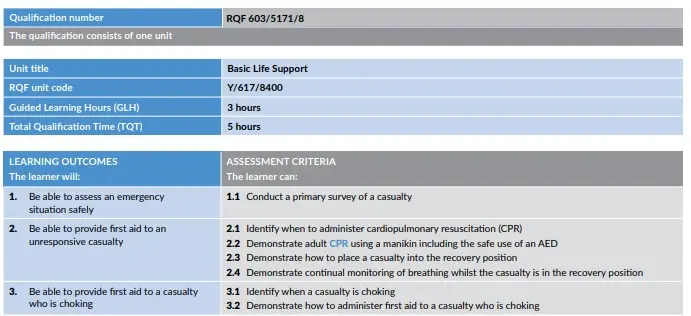
This basic life support qualification will give a learner the knowledge and practical competence required to be able to provide crucial assistance to a casualty in an emergency until medical assistance arrives, potentially saving a life.
The qualification covers cardiopulmonary resuscitation (CPR), the safe use of an automated external defibrillator (AED), primary survey, the recovery position and choking.
This qualification is regulated in the UK and awarded by First Aid Awards (FAA). FAA are an awarding organisation regulated by Ofqual and SQA Accreditation and the qualification sits on the Regulated Qualifications Framework (RQF). The qualification is delivered, assessed, and quality assured adhering to the Assessment Principles for Regulated First Aid Qualifications, and delivered and assessed in accordance with the current Resuscitation Council UK Guidelines
ENTRY REQUIREMENTS
The qualification is available to learners aged 14 or over but a learner cannot assume the responsibility of being a first aider in the workplace until they reach the age of 16.
It is recommended that learners hold a minimum of level 1 in literacy or equivalent to undertake this qualification. It may be possible to grant a reasonable adjustment for a learner who has a disability, medical condition or learning need following the FAA Reasonable Adjustment and Special Consideration Policy. For example, assistance could be given with reading or writing.
Due to the practical nature of the first aid assessment there are physical demands. Learners must be able to get to the floor unaided and successfully demonstrate all required elements of the practical assessment on their own, with the casualty on the floor, as in a real-life situation. For example, a learner will need to get to the floor unassisted and demonstrate effective cardiopulmonary resuscitation on a manikin at floor level.
If a learner has any concerns they should contact their training provider to discuss before attending the course.
QUALIFICATION DELIVERY
The qualification has 3 assigned guided learning hours (GLH) and 5 hours total qualification time (TQT). GLH indicates the number of contact hours that the learner will undertake being taught or assessed under the immediate guidance or supervision of the trainer/assessor in the classroom.
TQT includes GLH but also considers any unsupervised learning or preparation that a learner may undertake independently which could include self-study or the completion of set tasks.
The minimum classroom contact time of 3 hours can be delivered in half a day or can be completed over a maximum of 3 weeks ensuring that each session is a minimum of one hour. The learner ratio for the qualification is a maximum of 12 learners to 1 trainer/assessor
QUALIFICATION VALIDITY
The qualification is valid for three years from the date of achievement. It is strongly recommended that the learner attends annual refresher training.
Requalification
To requalify learners will need to complete the full 3-hour course again
QUALIFICATION ASSESSMENT
The qualification is assessed through practical demonstration.
There is no grading of the assessment, learners pass or are referred.
Practical assessment
Scenarios are set recreating a real-life situation as far as possible to enable a learner to demonstrate their knowledge and practical skills. During the practical assessment the learner will be asked set related oral questions by the trainer/assessor.
The practical assessment is ongoing throughout the course with the trainer/assessor making learners aware of when they are being assessed and what they are required to demonstrate. A learner must satisfactorily complete each scenario to pass the practical assessment
Scenarios are set recreating a real-life situation as far as possible to enable a learner to demonstrate their knowledge and practical skills.
During the practical assessment the learner will be asked set related oral questions by the trainer/assessor.
QUALIFICATION STRUCTURE
The qualification consists of one unit which learners must successfully complete to achieve the qualification.
Learning outcomes and assessment criteria
FAA qualifications have set learning outcomes and assessment criteria. The learning outcomes describe the skills and knowledge a learner will gain by successfully completing the qualification. The assessment criteria state the skills, knowledge, and competence a learner will be required to demonstrate during assessment.